Label Error Detection Using Confident Learning
Confident learning finds mislabeled training data before it corrupts your model.
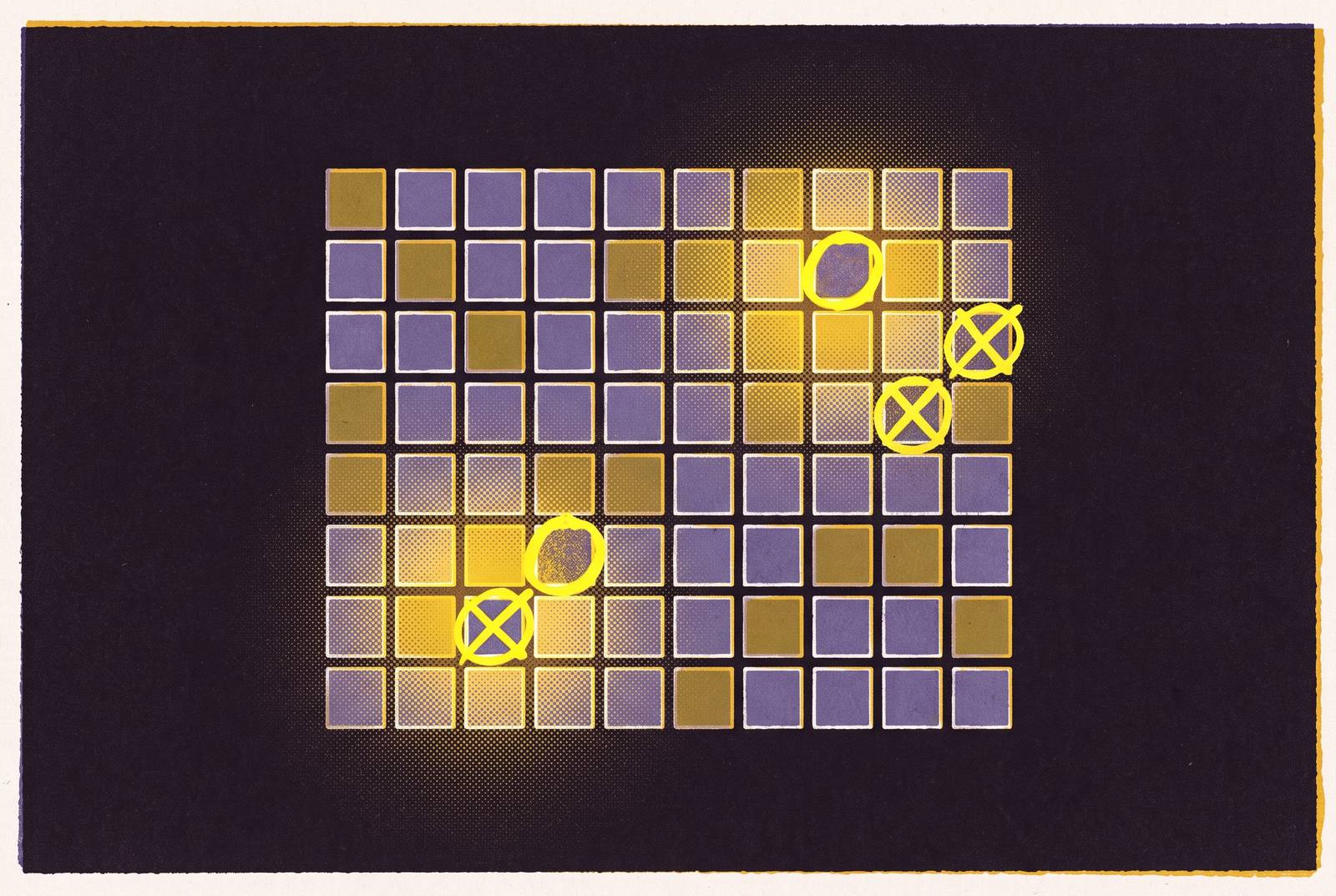
Label errors sit inside the training data of nearly every major benchmark in machine learning, and confident learning is the tool that turns finding them into a solvable, provable problem instead of a guessing game. It has become the practical foundation for cleaning datasets before they poison a model. Those errors don't hide in obscure corpora nobody checks. They sit in the exact test sets researchers cite to prove a model works.
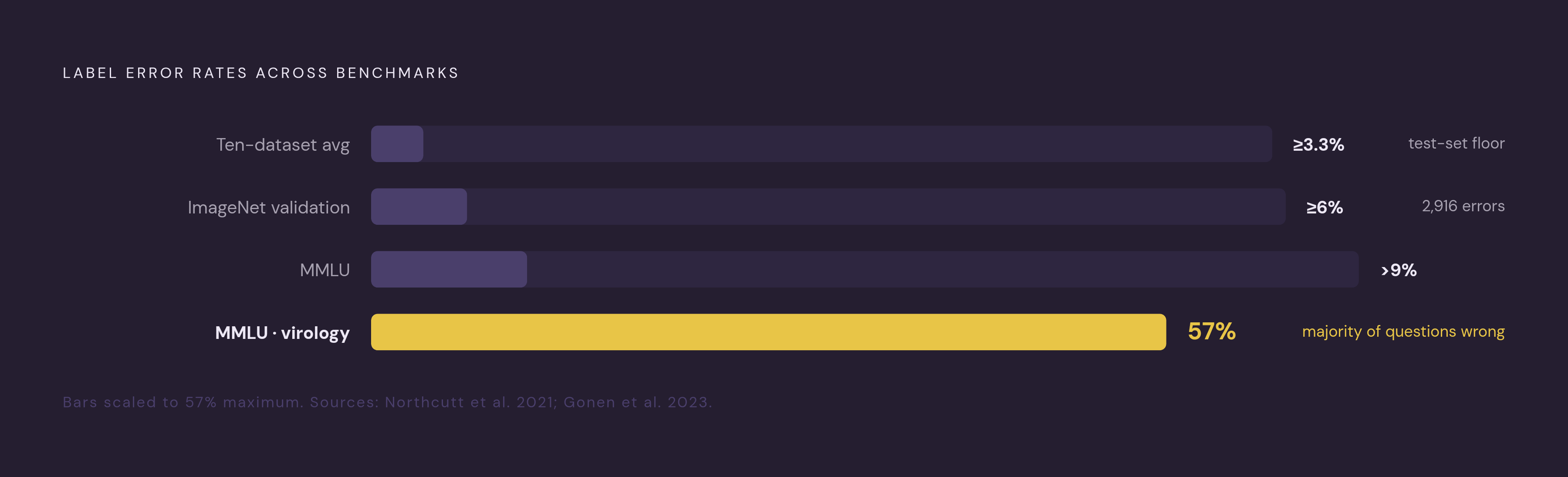
A study covering ten benchmark datasets across computer vision, NLP, and audio found an average error rate of at least 3.3% in the test sets alone, the portion of the data everyone assumes is clean because it decides which model wins. ImageNet's validation set, arguably the most scrutinized image dataset in the field's history, contains 2,916 label errors, at least 6% of the set: missiles mislabeled as their parent class projectile, one class quietly swapped for another. The MMLU benchmark, widely used to grade large language models, has more than 9% of its examples wrong, and within the virology subset alone, 57% of the questions analyzed contain some kind of error. Those numbers matter because of what rides on them. Practitioners pick which model to deploy based on test accuracy, so a test set full of errors can hand the win to the wrong model, and a smaller, cheaper model can end up more useful in production than the one that only looked better on a flawed benchmark. That's a substantial error in accuracy, and it's choosing the wrong system for the job and never finding out. That's choosing the wrong system for the job and never finding out.
Model-centric approaches to noisy labels that treat symptoms rather than causes
Most of the field's response to label noise has been to work around it instead of removing it. Specialized architectures, regularization schemes, noise-robust loss functions, loss adjustment tricks: all of these treat the dirty dataset as fixed and try to limit the damage it does downstream. That instinct makes sense on a deadline, but it treats noise as a permanent condition to manage rather than a defect to remove, and that's the wrong bet to keep making.
Only a small slice of the research treats the data itself as the thing to fix. This data-centric view, sometimes called data cleansing, tries to find and remove bad labels before a model ever sees them. The real argument is in the asymmetry between the two approaches. Model-centric methods bolt complexity onto the model, layer by layer, technique by technique, and that complexity has to get re-derived every time the architecture changes. Data-centric methods fix the dataset once, before training starts, and every model trained on that data afterward inherits the benefit for free. One fix, compounding value, against a pile of patches that need re-tuning on every new architecture. Once that asymmetry is visible, treating label noise as a first-class problem rather than a nuisance to route around stops being a matter of taste.
How confident learning formalizes the problem of finding mislabeled examples
The foundational paper is Curtis Northcutt, Lu Jiang, and Isaac Chuang's "Confident Learning: Estimating Uncertainty in Dataset Labels," published in the Journal of Artificial Intelligence Research (Vol. 70, pp. 1373-1411). Confident learning, or CL, reframes label noise as a quantity you can estimate directly, not a nuisance to smooth over during training. It rests on three moves: pruning noisy data out of the training set, counting with probabilistic thresholds to estimate how much noise exists in the first place, and ranking examples by how much confidence the process has in their labels.
One assumption does all the load-bearing work here: label noise is class-conditional. Formally, p(ỹ | y, x) = p(ỹ | y). The probability of observing a noisy label ỹ depends on the true class y*, not on the specific features x of the individual example. A photo of a fox is more likely to get mislabeled as a wolf than as a submarine, and CL assumes that tendency holds steady across every fox photo in the dataset, regardless of what's actually in the frame.
That assumption is what makes CL model-agnostic. It works from out-of-sample predicted probabilities, so it isn't tied to any particular architecture or data type. Whether the underlying classifier is a convolutional network on images or a transformer on text, CL's machinery for estimating the noisy-to-true label mapping doesn't change. That portability, more than any single technical trick, explains how far the framework spread.
Why softmax probabilities alone underestimate model uncertainty
Standard CL leans on softmax probabilities as its measure of self-confidence, and that choice is a real liability, not a shortcut worth keeping. Softmax outputs are notoriously poorly calibrated: a model can hand back a high softmax score for a prediction it is, in any meaningful sense, unsure about. If the confidence scores feeding CL's "confident joint" estimation are themselves miscalibrated, the thresholds used to flag likely label errors are built on a shaky signal from the start.
A family of algorithms called UQ-LED (Uncertainty Quantification Label Error Detection), developed by Jakubik, Voessing, Maskey, Wölfle, and Satzger and published in JAIR, fixes this by combining CL with proper uncertainty quantification instead of raw softmax output. Monte Carlo Dropout (MCD) runs multiple forward passes through the network and combines the results into a single probability estimate before it ever reaches the CL algorithm, effectively building a homogeneous ensemble out of one model. Model uncertainty measures get folded in on top of that, entropy in particular: the CL-MCD-E variant adds an entropy threshold alongside the standard CL confidence threshold, so a sample's flagging incorporates both the standard CL confidence threshold and an entropy-based uncertainty measure. Ensemble learning adds a further layer of calibration on top of that. Taken together, these adjustments push CL's error detection past what a single, uncalibrated softmax score could ever support on its own.
What CL misses when label noise is systematic across social groups
Class-conditional noise, the assumption behind standard CL, treats errors as uniform within a class. A cat mislabeled as a dog is a cat mislabeled as a dog, regardless of whose photo it is or what population it came from. That assumption breaks the moment label noise turns systematic across social groups instead of evenly distributed within a class, a pattern researchers call label bias. Standard CL cannot catch it, because the class-conditional model was never built to look for group-dependent patterns.
DeCoLe, short for Decoupled Confident Learning, proposed by Yunyi Li, Maria De-Arteaga, and Maytal Saar-Tsechansky, closes that gap. It decouples the error-detection process so it can account for label bias across social groups, rather than assuming noise behaves the same way for everyone inside a given class. That's a different problem than the one original CL was built to solve, and DeCoLe treats it as its own category instead of folding it in as an edge case of ordinary noise.
How CL performs in practice across domains
CL's track record spans medical imaging, text classification, and object detection, and the results are strong enough to take seriously, and far from uniform.
In medical imaging, a study published in Diagnostics paired CL with a human-in-the-loop re-annotation process to catch pixel-level labeling errors in retinal image segmentation. Two CL-based strategies were tested: Confident Joint Analysis (CJA), run with a DeeplabV3+ architecture on a ResNet-50 backbone, and Prune by Noise Rate (PBNR), run with ResNet-18, both applied across four public retinal datasets: HRF, STARE, DRIVE, and CHASE_DB1. The pixel-level labeling demands of medical segmentation tasks make this kind of label correction particularly consequential, since boundary errors carry real clinical weight.
In NLP, CL pre-processing has been applied to text classification on noisy corpora by estimating the joint distribution between the noisy labels given and the uncorrupted labels that produce them.
The gap between promise and performance in object detection is caused by annotation and evaluation flaws, and it is visible in benchmark results such as those measured on the KITTI dataset. REC✓D (Rechecked), a modular framework built by Penquitt et al., was applied to the pedestrian class in the KITTI dataset using crowdsourced corrected annotations, and it turned up 18% missing or inaccurate labels in KITTI's original ground truth, a dataset that has served as a standard benchmark in autonomous driving research for years. Even so, the paper's own benchmarking shows that the best current detection methods still miss up to 66% of label errors. That's the clearest evidence available that label error detection in object detection remains unsolved, not nearly there. REC✓D's modular design is intended to give the field a more rigorous foundation for evaluating segmentation and detection error detection going forward.
Precision swings hard by dataset, and that swing is the detail practitioners should sit with longest. In the ten-dataset benchmark study, 54% of the examples CL flagged as likely errors were confirmed as genuine errors through crowdsourced human validation, a solid hit rate. In the Wake Vision TinyML dataset, only 12 to 16% of CL-flagged candidates turned out to be real errors. Treat CL's output as a list of candidates that need checking by a person, never as a set of corrections to apply on faith.
The cleanlab library as the practical entry point for applying confident learning
Cleanlab is the open-source package that turned CL theory into something a practitioner can run against an actual dataset, and it has become close to the standard tool for data-centric AI and label error detection in Python. It implements the broader family of CL algorithms rather than one narrow technique.
The library was built by Curtis Northcutt, who holds a PhD from MIT and is the lead author of the original confident learning paper. Northcutt is CEO of Cleanlab, the company behind the library.
In practice, it takes an existing model's predictions and uses them to estimate problems in the dataset that model was trained on: mislabeled examples, unreliable annotators, outliers sitting where they shouldn't be. From there it can help train models that hold up better against whatever noise remains. The library is designed to keep the barrier to entry low, not as an afterthought.
The theory behind it is what earns the trust, not the convenience. Cleanlab's guarantees include provable, exact estimation of label noise even when the underlying model's outputs are imperfect. That's a different claim than "this heuristic tends to work," and it's the reason CL got adopted as seriously as it has across such different domains.
What practitioners should take from CL's guarantees and its remaining open problems
Confident learning has earned its place as a principled, model-agnostic framework for estimating the relationship between noisy labels and the true labels that produce them. It isn't a heuristic bolted onto an existing pipeline. It comes with provable consistency guarantees, it works across data types and model architectures without modification, and cleanlab has cut the barrier to trying it down to a single line of code. Cleaning a dataset before training on it beats training on more data that still carries the same uncorrected noise, and that data-centric argument holds up on its own, without needing a model-centric fallback to prop it up.
The extensions built on top of CL close gaps the original framework left open, rather than replacing it. UQ-LED corrects for softmax's poor calibration by bringing in Monte Carlo Dropout and entropy thresholds, so confidence estimates reflect real model uncertainty instead of an overconfident score. DeCoLe takes on label bias across social groups, a category of noise the class-conditional assumption was never built to catch.
None of this makes CL a finished project. Object detection results, where even strong methods still miss the majority of label errors by REC✓D's own benchmark, show how much ground is left to cover. Precision swings from 54% down to 12-16% depending on the dataset, and every flagged error still needs a human, or some secondary process, to confirm before anyone treats it as ground truth. What CL actually delivers is a way to turn label noise from an invisible, unmeasured liability into something a practitioner can estimate, rank, and act on. That shift, on its own, is worth the one line of code it takes to start.
Sources
- Improving Label Error Detection and Elimination with Uncertainty Quantification
- Bias-Aware Mislabeling Detection via Decoupled Confident Learning
- From Label Error Detection to Correction: A Modular Framework and Benchmark for Object Detection Datasets
- Confident Learning: : Estimating Uncertainty in Dataset Labels: Journal of Artificial Intelligence Research: Vol 70, No null
- Confident Learning-Based Label Correction for Retinal Image Segmentation
- Improving Label Error Detection and Elimination with Uncertainty Quantification
- github.com
- jair.org