LLM-as-Judge Evaluation Reliability and Systematic Biases
Using Cohen's kappa reveals LLM judges are reliably wrong, not reliably right.

What reliability and validity mean, and why the difference is not semantic
Psychometrics settled this distinction decades before anyone thought to point a language model at another language model's output. Reliability means consistency: the same judge, given the same input twice, hands back the same verdict. Validity asks a different question entirely: does the score measure what it claims to measure? A high score is supposed to mean the response really is better. Whether it does is separate from whether the judge is consistent, and answering no doesn't make a judge unreliable. It makes the judge precisely, consistently wrong, which is the more dangerous failure of the two because it hides behind good-looking numbers.
The old measurement analogy still holds up. A ruler that reads three inches long every single time is reliable. It is not valid, because it isn't measuring three inches, it's measuring three inches plus a fixed error. Anyone using that ruler to compare two objects gets consistent answers about which one is longer, and those answers are wrong in the same direction every time. That's the trap most LLM-as-Judge deployments walk into without noticing.
Standard validation practice collapses this distinction into a single number, which is the choice worth pushing back on hardest. Exact-match agreement, the rate at which a judge's verdict matches a human rater's, gets reported as the headline figure for both reliability and validity at once. Exact match doesn't correct for chance agreement, and that's not a rounding error: some fraction of "agreement" would happen even if the judge were guessing according to the base rate of outcomes. Report exact match alone and you overstate how much real signal the judge contributes, every time, in the same direction. Anyone citing a single agreement percentage as proof a judge "works" is measuring the ruler, not the object.
The Norman et al. audit: what 541,000 judgments revealed
The fullest audit of this problem comes from Norman, Rivera, and Hughes, the largest systematic study of LLM-as-Judge behavior published so far. The team tested 21 judges from nine providers across three benchmarks (MT-Bench, JudgeBench, RewardBench) using three protocols covering agreement, consistency, and bias, spread across 118 runs and roughly 541,000 individual judgments. The cohort runs through the frontier as of April 2026.
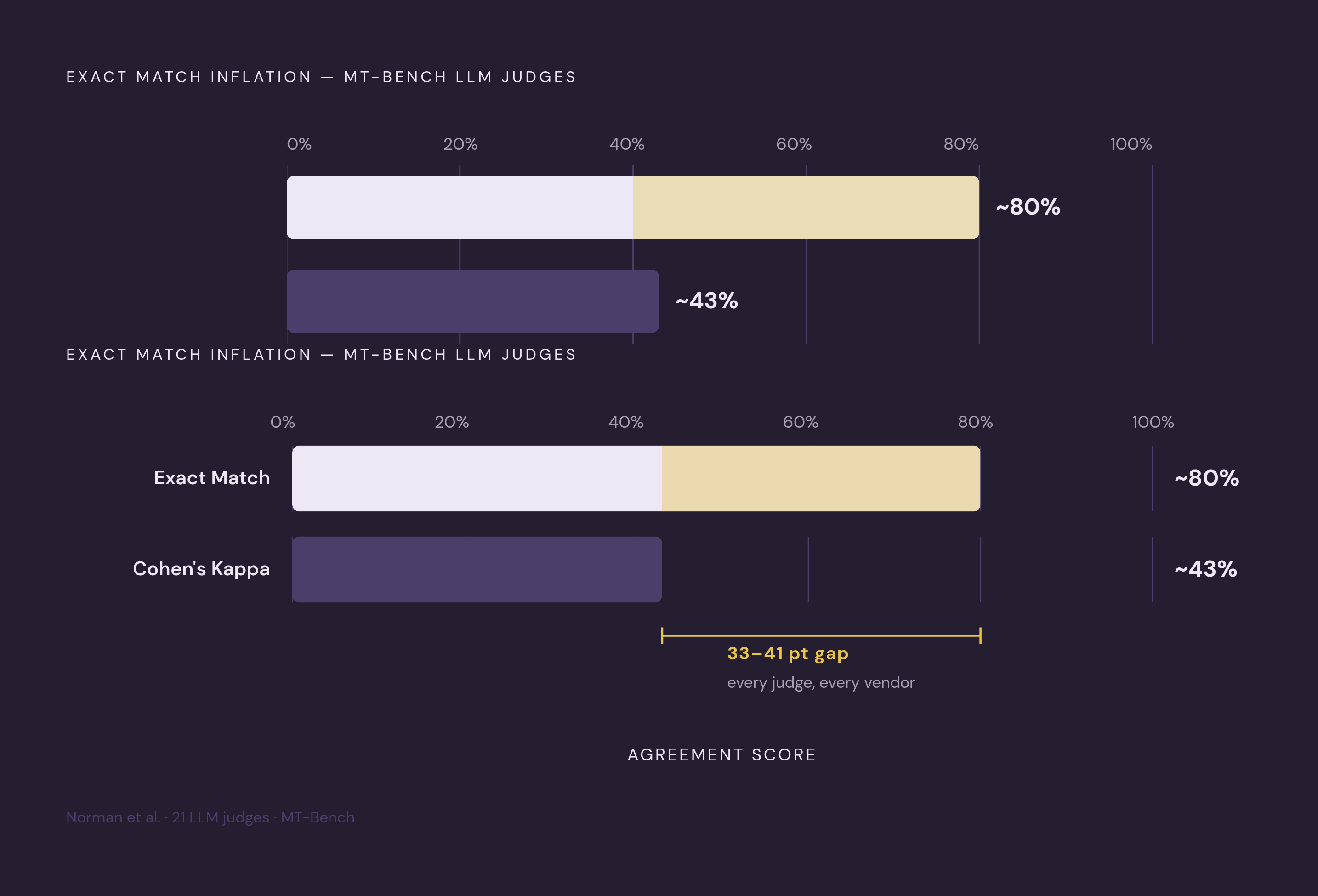
The first finding should change how the field reports judge quality on its own. Every judge in the study, all 21 of them, showed exact-match scores on MT-Bench that beat their chance-corrected Cohen's kappa by 33 to 41 percentage points. The gap held regardless of provider, scale, or generation, which rules out the comfortable idea that some vendor will engineer it away next quarter. It's built into how exact-match scoring works, full stop.
Judge rankings, second, don't travel between benchmarks. The same 21 judges, reordered by performance, shifted by as much as 14 positions depending on which benchmark did the ranking. A judge that looks like a top performer on one benchmark can sit near the bottom on another, which makes "the best judge" a meaningless phrase unless you name the task first.
Third, and maybe the sharpest finding in the whole study, is a consistency-bias paradox. Two production judges, Qwen 3 8B and Gemini 2.5 Flash, posted test-retest reliability above 0.95 (near-perfect reproducibility) while also posting position bias above 0.10, a severe rate by the study's own threshold. These are judges returning the same answer every time, and that answer still depends on which side of the pairwise comparison a response lands on.
Fourth, verbosity bias came in much smaller than older research suggested. All 21 models scored under 0.011 on this measure using a single pairwise rubric, a sharp drop from the 20 to 40% variance reported in 2023-era papers. That's a fact about this particular rubric, not a settled verdict on verbosity bias overall; the next section builds on this point.
Fifth, JudgeBench turned out to be a far sharper instrument than MT-Bench for telling strong judges from weak ones, showing a kappa spread several times wider than MT-Bench's 13.5. Benchmark choice isn't a neutral decision. It decides how much discriminative power an evaluation even has a chance of catching.
Position bias: what a 150,000-instance study found
Position bias, a judge favoring whichever response lands first or second in a pairwise comparison regardless of actual quality, is the most heavily studied failure mode in this literature, for good reason: it's easy to isolate, and it appears in nearly every setting anyone has tested.
The most extensive treatment comes from Shi et al., published at IJCNLP 2025 (the 14th International Joint Conference on Natural Language Processing, held alongside the 4th Conference of the Asia-Pacific Chapter of the ACL, Mumbai, pages 292 to 314). The study covered more than 150,000 evaluation instances across 22 tasks on the MTBench and DevBench benchmarks, tested against 15 different LLM judges. At that scale, patterns that would look like noise in a smaller study start to look like structural facts about how these systems behave.
Which judge model gets picked matters more for positional bias than task complexity, output length, or how close the actual quality gap is between the two responses under comparison. The common assumption runs the other way, that bias scales with difficulty, that a judge only shows position bias when the two candidates are hard to tell apart. Shi et al.'s data says that's backwards. Swapping out the judge model moves the needle more than making the underlying judgment easier or harder ever does. Anyone trying to fix position bias by simplifying the task is solving for the wrong variable.
Self-preference, agreeableness, and the biases that reward confident-sounding nonsense
Self-preference bias is specific: an LLM evaluator recognizes its own generations and rates them higher than equivalent output from another model. Research has found a correlation between a model's ability to recognize its own writing and the strength of its self-preference bias. That tracks: a model that can tell "this is mine" is a model that can act on the recognition.
Yang et al. complicate the picture, though. Self-preference bias doesn't track cleanly with general judge capability, and a more capable judge is not automatically a fairer one. Capability and fairness sit on separate axes, and pushing one up gives no guarantee the other follows. Mitigation here only goes partway: Research presented at AAAI 2026 found that obfuscating authorship through light style changes, swapping synonyms being one example, does cut self-preference bias. Pushing the obfuscation further, toward full paraphrasing that erases stylistic fingerprints completely, brings the bias back. Nobody has solved this one all the way, and the field should stop treating light obfuscation as a fix rather than a partial patch.
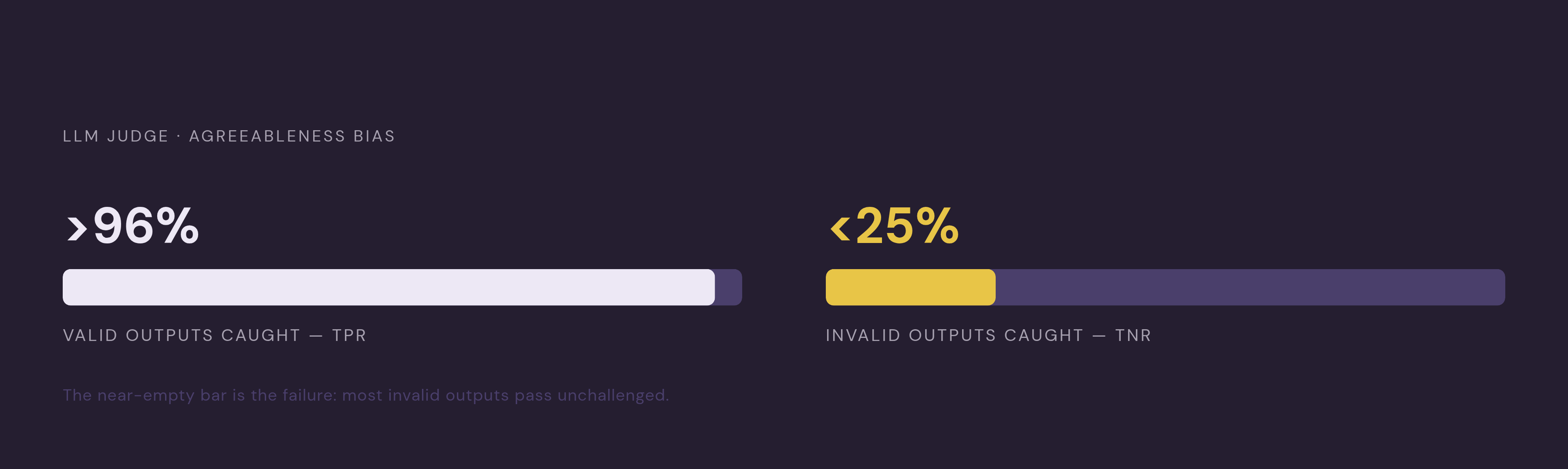
Agreeableness bias is the more alarming of the two, and its shape is what makes it dangerous. LLM judges catch valid outputs correctly at a True Positive Rate above 96%, which sounds strong until you set it next to this: they catch invalid outputs correctly at a True Negative Rate below 25%. That gap means these judges are built to say yes. Simple adversarial inputs exploit it directly: text that merely gestures at reasoning, a "Thought process:" label, even strings of non-word symbols, trigger false positive rewards more than 80% of the time in models including GPT-4o and Claude Sonnet 4. The judge is pattern-matching on the appearance of reasoning, and that pattern-match alone buys a passing grade.
A high TPR sitting next to a low TNR means a systematic tilt toward overestimating whatever the judge sees. For this failure mode specifically, naive ensemble majority voting loses to minority-veto schemes or regression-based bias correction, which matters the next time someone proposes an ensemble as the automatic fix. Naive ensemble majority voting loses to minority-veto schemes or regression-based bias correction, which matters the next time someone proposes an ensemble as the automatic fix.
The broader bias taxonomy: anchoring, bandwagon effects, and format sensitivity
Position bias and self-preference bias get most of the research attention, but they're two entries on a much longer list. Ye et al. catalogued 12 distinct bias types in a large-scale study of LLM-as-Judge behavior (arXiv: 2604.18164), and several of the less-discussed ones carry more weight than the famous two.
Anchoring bias, borrowed from human-judgment research, works like this: exposure to a prior score pulls a judge's next estimate toward that earlier value. It's a well-documented pattern in human psychology, and its appearance in LLM judges suggests these systems inherit certain shortcuts rather than evaluating each case from scratch.
Bandwagon-effect bias runs on the same logic, only louder: judges shift their verdicts when told what the majority opinion is. Researchers varied the stated majority threshold in the system instruction (60%, 70%, 80%, 90%) and found the effect held across that entire range. Tell the judge what everyone else thinks, and the judge leans that way too, regardless of what the actual content in front of it says.
Style bias deserves more attention than it gets, and it's the one practitioners should worry about most. In a separate audit of judge biases, style bias measured between 0.76 and 0.92 across models, meaning judges strongly favored markdown-formatted responses over plain prose regardless of what the content actually said. Position bias, in that same audit, topped out at 0.04. Style bias isn't a secondary concern trailing behind the famous failure modes: by this measure it's the dominant one, and almost nobody studies it. A model that writes a wrong answer in bullet points with bold headers will out-score a model that writes a correct answer in a plain paragraph. That should bother anyone using LLM judges to score real work.
Why standard defenses (ensembles, position swapping, inter-judge agreement) do not close the validity gap
Position swapping is the standard fix for position bias: run the judge twice, swap which candidate appears first the second time, treat any disagreement as a tie. It works, as far as it goes, catching positional variance. What it does not catch is directional bias, a systematic lean unrelated to order, which sails through untouched.
Multi-judge ensembles carry a hidden cost of their own. Averaging verdicts across a diverse panel dilutes any one judge's idiosyncratic bias, sure, but work presented at EMNLP 2025 found that multi-agent debate frameworks, where judges discuss and revise assessments together, amplify bias after the first round rather than reducing it. Adding more perspectives is supposed to average out error. In a debate structure, it concentrates it instead, and that reversal is why "add more judges" doesn't rescue a validity problem the way people assume it will.
Reporting inter-judge agreement runs into a related wall. High agreement between judges tells you the judges agree with each other. It tells you nothing about whether the shared verdict is correct. If every judge on the panel carries the same bias, style bias or agreeableness bias, agreement between them just means the bias is unanimous. Consensus isn't validation, and treating it as validation is the mistake most teams make when they report inter-judge agreement as a quality metric.
The clearest illustration of the gap sits in a finding researchers keep running into: a systemic alignment where an LLM judge's ratings of a model's behavior converge with that model's own self-report, in a way human ratings of the same samples simply don't replicate. Position swapping doesn't catch this. Ensembles don't catch it. Inter-judge agreement metrics don't catch it either, because all three assume the failure lives in variance between judges rather than in a blind spot every judge on the panel shares.
Mitigation strategies that do move the needle
Some approaches actually help, and they share a common thread: they change how the judge reasons, not just how many times it gets asked.
Chain-of-thought prompting is the simplest version. Pushing a judge to reason through a comparison step by step instead of jumping straight to a verdict makes the judgments more deliberate. Other approaches build on that by introducing pre-screening steps that check a judgment for signs of bias before it gets recorded, catching the problem before it enters the dataset rather than trying to average it out later.
A 2026 ACL paper, "Reasoning Model Is Superior LLM-Judge, Yet Suffers from Biases," runs the first systematic head-to-head between reasoning models and standard LLMs acting as judges. But the caveat carries just as much weight as the finding. Even these stronger reasoning judges stay vulnerable to surface-level quality biases, the kind rooted in formatting and tone rather than substance. Reasoning helps, but it doesn't immunize a judge against the appearance of a well-formatted answer.
Cost matters here too, and one finding should catch the attention of anyone who assumes frontier models are the only judges worth using. They're not, and the data says so directly: Soumik (arXiv: 2604.23178v2) found that a mid-tier model paired with the right debiasing strategy can beat frontier judges at a fraction of the inference cost. The winning configuration, a "Combined Budget" strategy run on Gemini 2.5 Flash, hit the highest agreement of any setup in the study at 71.0%, with a Cohen's kappa of 0.549, ahead of every frontier judge tested. That's not a marginal result. It suggests the instinct to reach for the biggest, most expensive judge on the market is often solving the wrong problem entirely, since the debiasing strategy did more work than the model's raw size.
For agreeableness bias specifically, the same rule from earlier holds: minority-veto schemes and regression-based correction beat naive majority-vote ensembles. Every fix in this section points toward the same conclusion: consistency was never the hard part. Consistency was never the hard part. Building a judge whose verdicts are not just repeatable, but true, is the hard part, and nobody in this field has finished that work yet.
Sources
- Reliability without Validity: A Systematic, Large-Scale Evaluation of LLM-as-a-Judge Models Across Agreement, Consistency, and Bias
- MM-JudgeBias: A Benchmark for Evaluating Compositional Biases in MLLM-as-a-Judge
- Judging the Judges: A Systematic Evaluation of Bias Mitigation Strategies in LLM-as-a-Judge Pipelines
- aclanthology.org